
Could 2026 Finally be the Year of the Linux Desktop?
When I started my position as research software engineer, I also started using Windows as my operating system. The reason is simply that most of the researchers I teach and consult also use Windows (about 60-70%) and using the same operating system makes collaboration much easier. However, I can’t say I’m enjoying it. Windows is full of ads and bloatware, ridden with bugs and, whenever I want to customize anything, I run into guardrails. Also, it is just incredibly slow - how can opening a terminal on a modern computer take over a second?
Because I built up a lot of frustration over Windows, I cried out in excitement when, on a recent episode of the Standup podcast 1, game developer Casey Muratori predicted that 2026 might go down in history as the tipping point where Linux started to become a major player in the desktop market because Windows is going to continue to get worse:
… it’s all just based on fear of what Microsoft is doing to Windows and it not being a stable platform, which was the only point of using it in the first place, right? The only point of paying for it is that it was supposed to be more stable, easier to maintain, you know, more turnkey and all that stuff. Soon as that stuff isn’t true anymore […] why are you there?
So is this true? Could 2026 really be the year where Linux is taking over? I know the “year of the Linux desktop” meme is old, but I want to give three reasons why this time may be different.
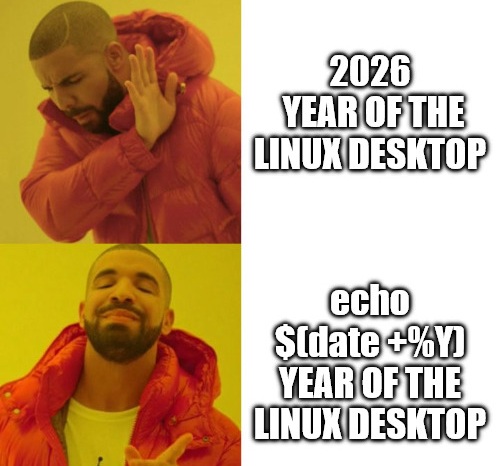
Is 2026 the year of the Linux desktop? Of course, every year is the year of the Linux desktop!
1. Windows is Getting Worse
Indeed, the Windows platform saw a marked decline in 2025 with many users complaining about half-baked and unwanted features that are being shipped as well as bugs and crashes in many core utilities 2. In addition to the known issues with existing software, Microsoft seems to have the unbridled desire to put as many AI features as possible into the operating system which will inevitably be harmful for security and performance. Microsoft’s reaction to the negative PR around this was a weird blog post by CEO Satya Nadella who said we should “get beyond the arguments of slop vs sophistication” 3 - An absurd statement which was appropriately ridiculed with the “Microslop” meme.
This could very well be the future (credit: @apathei on X)
So far, we haven’t seen a large migration because the gravitational pull of Windows and the Office suite is still very strong. However, Microsoft’s continuous alienation of its users creates the conditions under which many are willing to try alternatives. The moment Windows stops being the unquestioned default operating system, these users will not hesitate to jump ship. So, how realistic is it that desktop Linux becomes a serious contender that challenges Windows’ hegemony? I think the numbers look pretty promising!
2. Linux is on the Rise
While Linux has long been the most popular OS for servers, it struggled to gain traction for desktop computers. It took Linux two decades, from its creation in 1991 to 2011, to reach a global market share of 1% and another decade to hit 2% in 2021. However, this is where things accelerated: The transition from 2% to 3% took just over 2 years and the move from 3% to 4% happened in under a year 4! While the development has slowed a bit recently with the market share in 2025 being reported at 4.7% globally, this is still a massive increase in popularity that would have been hard to predict 5 years ago.
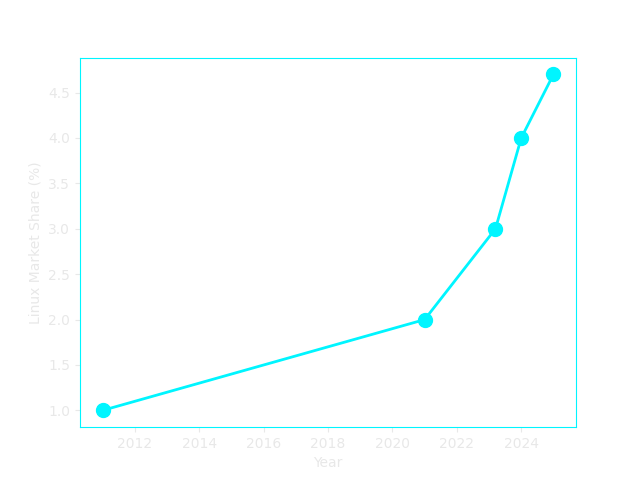
The share of desktop computers running Linux over the last 15 years.
Among other factors, this trend is driven by Linux becoming a viable platform for gaming, thanks in large part to the involvement of publisher Valve and the development of the Proton compatibility layer that allows Windows games to run on Linux. Valve demonstrated that you can build commercially successful gaming products on Linux and continues to direct money and developers towards Linux, improving driver stability and kernel performance 5. In 2025, the company announced the Steam Machine, a gaming console that runs SteamOS - an operating system based on Arch Linux. The interesting thing about the Steam Machine is that it can be used in “desktop mode” as a regular Linux PC. This opens up the possibility that users who bought the device for gaming might also end up using it as their daily desktop.
2025 also saw an increase in the Linux-related content created by large YouTubers. Two prominent examples are PewDiePie, who talked about his experience installing and customizing Linux 6, and LinusTechTips who interviewed Linux creator Linus Torvalds 7. These may seem insignificant, but just these two videos reached a total of 12 million viewers and they speak to an audience that may otherwise not take an interest in FOSS. In summary, there is clearly a lot of positive momentum for Linux, both in terms of technical development and public opinion, and I think there is another factor which might further tip the scale in favor of Linux.
3. Reliance on US Software is a Security Risk
In 2019, as the member countries began to auction contracts for the construction of 5G networks, the European Union debated whether Chinese manufacturer Huawei should be banned from taking part 8. Experts warned that Huawei could install backdoors which could be used by the Chinese government for digital surveillance and sabotage. Currently, the EU is trying to pass a new bill that seeks to root out risky Chinese technology vendors from tech supply chains across Europe 9.
However, while there is great risk-awareness regarding technical dependence on Chinese companies, the technical dependence on US companies is rarely discussed. A study from the Open Cloud Council (OCC) reported that EU government agencies and offices are heavily dependent on Microsoft’s products with market shares reaching up to 90% for office productivity software and 84% for collaboration tools 10. This means that the functioning of essentially the entire European public sector is at the mercy of a single company which is subject to control by the US government. In other words, if the US sought to sabotage the digital infrastructure of foreign countries, they would not need a backdoor - they can march right through the front gate. Just imagine the carnage that would ensue if the US were to sanction Europe by withdrawing access to Microsoft’s Office products.
A few years ago, this scenario would have sounded like a crazy conspiracy theory, but the increasingly hostile attitude of the US government is making it more plausible. China has realized this risk and reportedly banned Microsoft products (along with Intel and AMD chips) from government computers 11. There are similar pushes to adopt free and open source alternatives to Windows and Office across different ministries in Denmark, France, Italy, Spain, and Germany 12. While it is not clear how these efforts translate to the private sector and consumers, demand from the public sector could result in an increasing focus on free and open source software among manufacturers and IT service providers, which could in turn shape the private sector.
A Realistic Outlook
So that’s it - these are my reasons for being hopeful that Linux may soon become a major player in the desktop market. But what does “major” mean exactly? Will Linux replace Windows as the most popular Desktop OS? Probably not. Even though some Linux distributions (e.g. Ubuntu or Mint) have become very beginner-friendly, there is still some technical barrier to using Linux, simply because the power and flexibility Linux provides necessarily comes with greater responsibility of the user. However, Linux does not need to replace Windows to be taken seriously by manufacturers and service providers. If Linux were to reach a 10% market share, which is roughly double what it is now, it would be hard to ignore. Consider that macOS has a market share of 15-20% and there are a lot of businesses building their entire strategy on that platform. So while your grandma will probably never use Linux (and honestly, why should she), it could become the default choice for anyone who uses a computer professionally, and scientists certainly belong to that group.
-
Standup Podcast Episode: https://www.youtube.com/watch?v=vFcgXdm-0yY ↩︎
-
A post on broken core features in Windows: https://www.neowin.net/news/microsoft-finally-admits-almost-all-major-windows-11-core-features-are-broken/ ↩︎
-
Satya Nadella’s blog post: https://snscratchpad.com/posts/looking-ahead-2026/?v=1 ↩︎
-
Data on Linux market share: https://commandlinux.com/statistics/linux-desktop-market-share-yearly-trends/ ↩︎
-
Talk on Valve’s contributions to Linux: https://www.youtube.com/watch?v=h7YbqrJ0_nM&t=2s ↩︎
-
PewDiePie talking about Arch Linux: https://youtu.be/pVI_smLgTY0?si=A526bZHHTlzv91Vn ↩︎
-
LinusTechTips interview of Linus Torvalds: https://youtu.be/mfv0V1SxbNA?si=hJ7knuc6Ur2mNQXQ ↩︎
-
Whitepaper by the EU parliament discussing risks around 5G: https://www.europarl.europa.eu/RegData/etudes/ATAG/2019/637912/EPRS_ATA(2019)637912_EN.pdf ↩︎
-
Article on EU legislation for banning Chinese manufacturers: https://www.politico.eu/article/brussels-plans-force-governments-block-huawei-zte-5g/ ↩︎
-
Article on the OCC survey on Windows products in government: https://www.digitalsamba.com/blog/europes-dependency-on-microsoft-a-threat-to-its-digital-sovereignty ↩︎
-
Report on Chinese banning of Microsoft: https://fortune.com/asia/2024/03/25/beijing-bars-intel-amd-microsoft-windows-government-computers-tech-self-sufficiency-processors/ ↩︎
-
Two articles on Europe’s shift to open source: https://www.2-data.com/knowledge-hub/a-search-for-digital-sovereignty-eu-governments-shift-from-microsoft-to-linux-libreoffice and https://linuxfoundation.eu/newsroom/open-source-driving-europes-digital-future-key-insights-from-the-2024-lf-research-report-on-european-open-source-trends ↩︎